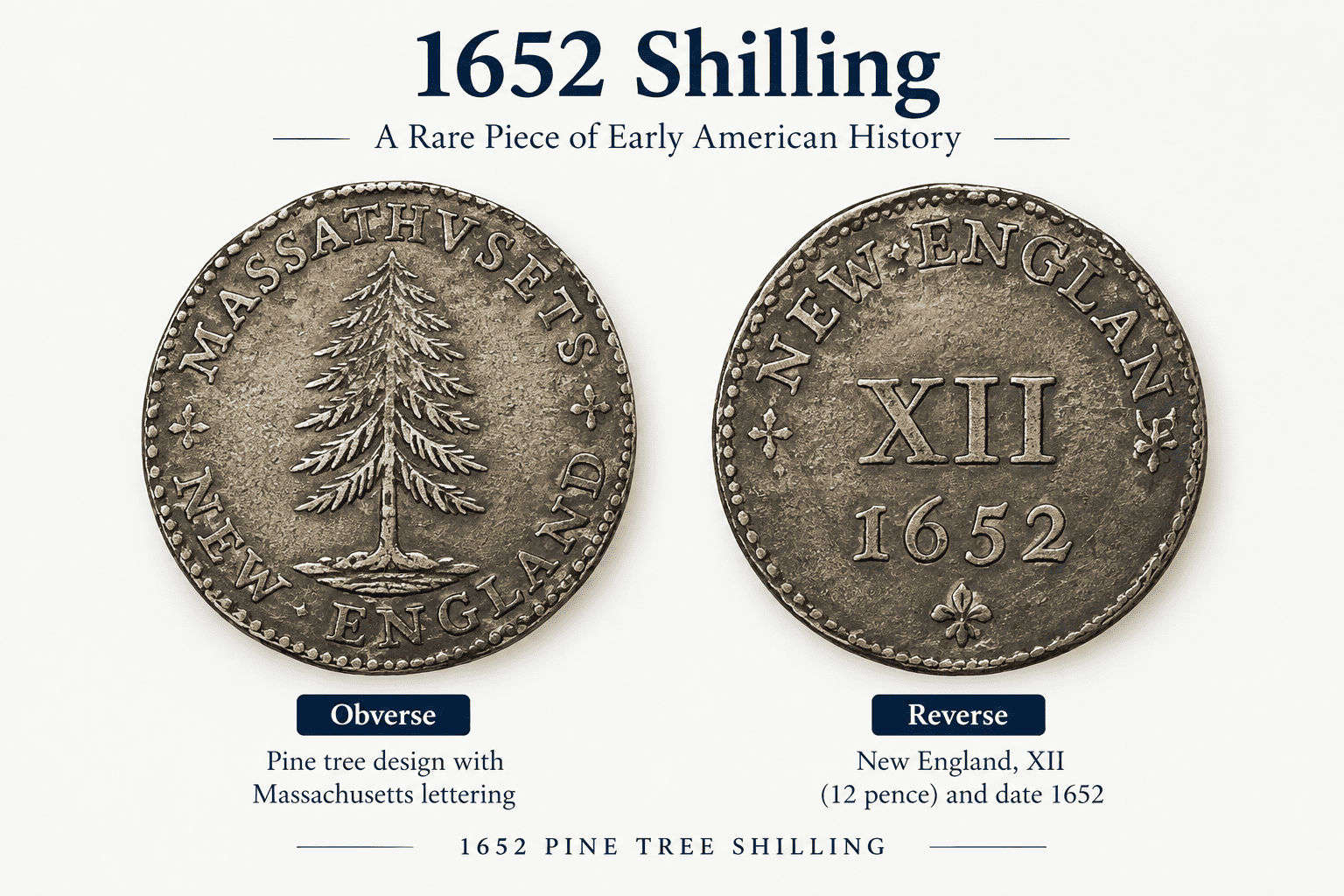
The 1652 shilling is one of the most interesting coins in early American history. It is also a coin that creates many questions for collectors.
We read now more about following points or questions:
- What is a 1652 shilling value?
- Is a 1652 pine tree shilling real or fake?
- How much is a 1652 New England shilling worth?
- What is the history of the 1652 oak tree shilling?
- Who made the Pine Tree Shilling?
- Was every 1652 shilling actually made in 1652?
A genuine 1652 shilling can be worth thousands of dollars. Rare examples can be worth much more. However, many copies, replicas, and counterfeits also exist.
This guide explains the 1652 shilling from A to Z in easy English. You will learn about its history, different tree designs, silver content, value, and how to avoid fake coins.
What Is a 1652 Shilling?
A 1652 shilling is an early colonial silver coin connected with the Massachusetts Bay Colony.
The Massachusetts government authorized local coin production in 1652. Boston silversmiths John Hull and Robert Sanderson operated the mint and produced silver coins in several denominations.
The famous series includes several main designs:
- New England coinage
- Willow Tree coinage
- Oak Tree coinage
- Pine Tree coinage
The 1652 pine tree shilling later became the most famous design in the series.
One important fact is that a coin showing the date 1652 was not necessarily struck during that exact year. The date 1652 continued to appear on later Massachusetts silver coins. Smithsonian examples of Pine Tree Shillings dated 1652 are identified as having been made between 1667 and 1682.
1652 Shilling History
Before the Massachusetts Bay Colony began making its own coins, people often used foreign coins, barter, and other forms of payment.
A shortage of reliable coinage created problems for trade.
In 1652, Massachusetts authorities allowed John Hull and Robert Sanderson to establish a mint in Boston. They began producing local silver coins, including threepence, sixpence, and shilling denominations.
This was a major moment in colonial American monetary history.
The 1652 shilling became part of an important early American currency system. These coins circulated in Massachusetts and were also accepted more widely in the region.
If you want more background about colonial money, the Wikipedia guide to early American currency provides additional historical context.
Who Made the Pine Tree Shilling 1652?
The people most closely connected with the Massachusetts silver coinage were:
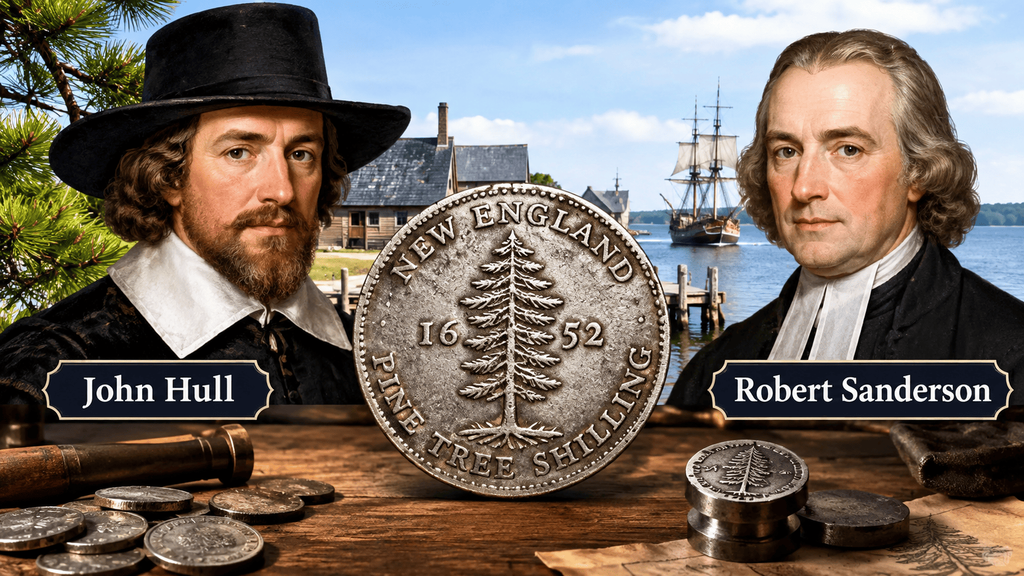
John Hull and Robert Sanderson made Shilling 1652.
John Hull was a Boston silversmith and was appointed as mint master. Robert Sanderson worked with him in the minting operation.
Their mint produced some of the most important coins of colonial America. The 1652 shilling series later became famous among historians and coin collectors.
Why Does the Coin Say 1652?
This is one of the most interesting parts of the 1652 shilling story.
The year 1652 was the year Massachusetts authorized the mint. However, the mint continued to make coins later.
Many later coins still carried the date 1652.
Why?
One explanation is that 1652 represented the founding year of the Massachusetts mint. Another historical explanation is connected with English politics.
At that time, England was a Commonwealth and did not have a reigning king. Minting coins was normally considered a royal power. Keeping the date 1652 on later coins may have helped Massachusetts connect the coinage to the period when there was no monarch on the throne.
Therefore, if you find a 1652 shilling, the date alone does not prove that the coin was physically made in 1652.
This is very important for collectors.
Types of 1652 Shilling Coins
The Massachusetts silver series changed over time.
The designs became more detailed and recognizable.
1. New England Shilling
The earliest Massachusetts silver pieces are often called New England coinage.
These early coins were simple in design. They used the letters NE, meaning New England, together with the denomination.
The 1652 New England shilling is one of the earliest and most historically important pieces from the Massachusetts series.
A genuine example can be extremely valuable because surviving coins are rare.
2. 1652 Willow Tree Shilling
After the simple New England design, the mint introduced the Willow Tree type.
The Willow Tree coins used a tree image inside the design. The 1652 willow tree shilling is now considered a scarce and important colonial coin.
The Willow Tree design was produced during the early years of the Massachusetts silver coinage.
Today, a genuine Willow Tree example can be worth a large amount, especially when the coin is rare and well preserved.
3. 1652 Oak Tree Shilling
The 1652 oak tree shilling came after the Willow Tree type.
The Oak Tree series generally followed a similar design format but replaced the willow image with an oak tree.
Oak Tree coinage was produced approximately from the early 1660s until 1667, depending on the variety and classification used by researchers.
The 1652 oak tree shilling history is important because these coins show the development of the Massachusetts mint.
Some Oak Tree pieces were struck using improved minting methods that could produce clearer and higher-quality designs than the earliest hand-struck coins.
A real 1652 oak tree shilling can have significant collector value.
4. 1652 Pine Tree Shilling
The 1652 pine tree shilling is the most famous type.
It features a pine tree on one side and inscriptions connected with Massachusetts and New England.
The Pine Tree design was produced after the Oak Tree series. The design became one of the best-known symbols of early colonial American coinage.
There are different Pine Tree varieties, including large planchet and small planchet examples.
The size, variety, rarity, condition, and authenticity can all affect the 1652 shilling value.
1652 Shilling Value: How Much Is It Worth?
There is no single answer to the question, how much is a 1652 shilling worth?
The value can vary greatly.
A genuine 1652 shilling value may be worth hundreds, thousands, or tens of thousands of dollars.
Very rare varieties can be worth much more.
Recent published pricing guides show large differences between varieties. For example, listed values for some Massachusetts Tree Shillings range from the low thousands to well over $100,000, depending on the exact type and grade.
However, these figures should not be treated as a guaranteed selling price.
The real 1652 shilling value depends on several factors.
Factors That Affect 1652 Shilling Value
1. Is the Coin Genuine?
This is the most important question.
A real colonial silver coin can be valuable.
A modern replica or counterfeit may have little collector value.
Always confirm authenticity before assuming that an old-looking 1652 shilling coin is valuable.
2. Which Variety Is It?
The exact type matters.
For example:
- New England
- Willow Tree
- Oak Tree
- Pine Tree
Different varieties have different rarity levels.
Some die varieties are also much rarer than others.
3. What Is the Condition?
Condition has a major effect on value.
Collectors generally pay more for coins with:
- Clear details
- Less damage
- Original surfaces
- Strong design
- Professional certification
A heavily worn genuine coin may still be valuable because of its age and rarity.
4. Has the Coin Been Professionally Graded?
Professional authentication can be very important.
Major grading companies such as NGC and PCGS examine coins for authenticity and condition.
For a valuable 1652 shilling, professional certification can help buyers feel more confident.
How Much Is a 1652 Pine Tree Shilling Worth?
The 1652 pine tree shilling value depends heavily on the exact variety.
Published auction and grading information shows that genuine Pine Tree Shillings can sell for thousands or tens of thousands of dollars.
For example, NGC reported that a genuine 1652 “Pellets” Pine Tree Shilling sold for $55,200 at a Heritage Auctions sale in August 2022.
PCGS also records historical auction sales for different Pine Tree Shilling varieties, with prices changing based on rarity and condition.
Therefore, never estimate the value of a 1652 pine tree shilling using the date alone.
The exact variety is essential.
1652 Pine Tree Shilling: Real or Fake?
Many people search for 1652 pine tree shilling fake because counterfeits are a serious problem.
A coin can look old and still be fake.
Counterfeiters may copy:
- The tree design
- The 1652 date
- Old-style lettering
- Surface wear
- Silver color
NGC has published counterfeit detection information specifically for the 1652 Pine Tree Shilling. It notes that genuine and counterfeit examples can look similar, which makes professional examination important.
Some cataloged varieties are also known to have counterfeit examples.
Do not buy an expensive 1652 shilling simply because it looks old.
Signs a 1652 Pine Tree Shilling May Be Fake
These signs do not prove a coin is fake, but they should make you careful:
Unusually Low Price
A seller offering a supposed rare colonial silver coin for a very small price should raise questions.
A genuine rare 1652 shilling normally has significant collector interest.
Identical Modern Examples
If many coins have exactly the same surface marks and details, they may be modern reproductions made from the same mold.
Incorrect Weight or Size
Authentic coins have known physical characteristics, although exact measurements can vary by type and historical production method.
The Smithsonian records Pine Tree Shilling examples as silver coins with documented measurements and identifies their different production periods.
Strange Metal Surface
A fake may have:
- Casting bubbles
- Artificial aging
- Unnatural color
- Incorrect edge details
- Mold seams
Poor Lettering
Collectors study the lettering, tree design, die characteristics, and other details.
A wrong letter shape or copied modern style can be a warning sign.
However, authentic colonial coins can also look irregular because they were produced with old minting technology.
That is why visual inspection alone is not always enough.
What Does a Genuine 1652 Shilling Look Like?
The appearance depends on the type.
A Pine Tree Shilling generally shows:
Front: A pine tree and Massachusetts-related lettering.
Back: New England lettering, the date 1652, and the denomination XII.
The spelling on genuine historical examples may look unusual to modern readers.
For example, Smithsonian records describe Pine Tree Shillings with lettering such as MASATHVSETS and NEW ENGLAND, with the denomination shown as XII.
Old spelling, irregular letters, and imperfect striking do not automatically mean the coin is fake.
Colonial coins were made differently from modern machine-produced coins.
1652 New England Shilling Worth
A genuine 1652 New England shilling can be extremely valuable because of its importance and rarity.
Pricing information published by Greysheet shows very high values for certain New England coinage examples, although the actual market price depends on the specific coin and current demand.
For this reason, a possible New England Shilling should be examined by an experienced colonial coin specialist.
Do not clean the coin before having it checked.
Cleaning can damage the original surface and may reduce collector value.
1652 Oak Tree Shilling History and Value
The 1652 oak tree shilling represents an important stage in the development of Massachusetts coinage. The Oak Tree series followed the Willow Tree type and came before the famous Pine Tree series.
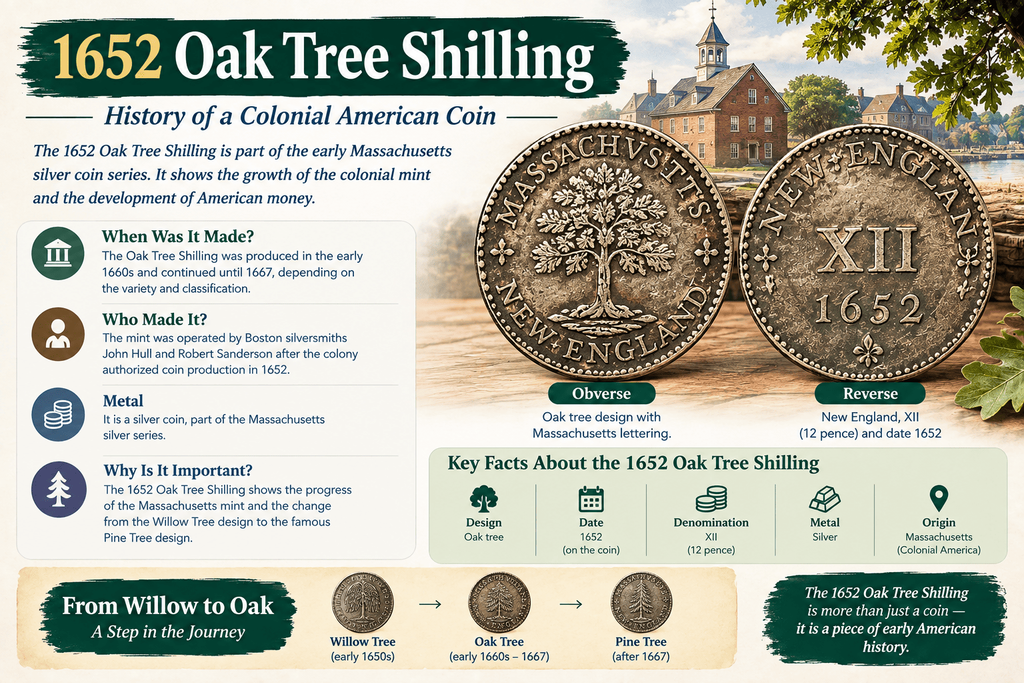
The basic design included an oak tree surrounded by lettering, while the reverse included the 1652 date and denomination.
The Oak Tree series also has different varieties.
Because of these differences, one 1652 oak tree shilling may have a very different value from another.
Published price information shows wide value ranges for Oak Tree Shillings, depending on the variety and condition.
Is the 1652 Shilling Made of Silver?
Yes. The Massachusetts shillings discussed in this guide are historic silver coins.
Smithsonian records identify the Pine Tree Shilling as silver.
However, finding silver in a coin is not enough to prove authenticity.
Modern counterfeiters can also use silver or silver-colored metals.
The metal must be examined together with the design, weight, measurements, die characteristics, and historical style.
How Much Money Was 20 Shillings in 1652?
In the traditional British monetary system, 20 shillings equaled one pound.
However, comparing that amount directly with modern money is difficult.
The buying power of money in 1652 depended on many factors, including:
- Location
- Local prices
- Wages
- Available goods
- Type of currency
Therefore, saying that 20 shillings from 1652 equals one exact amount in today’s dollars can be misleading.
For historical understanding, it is better to remember that 20 shillings represented one pound in the traditional pound-shilling-pence system.
Should You Buy a 1652 Pine Tree Shilling for Sale Online?
You should be very careful.
Before buying a 1652 pine tree shilling for sale, check:
- Is the seller reputable?
- Is the coin professionally authenticated?
- Does it have a certification number?
- Can you verify the certification?
- Is the exact variety identified?
- Are clear photos available?
- Is there a return policy?
- Does the price make sense for a rare colonial coin?
For expensive coins, buying from a respected dealer or auction company is generally safer than purchasing an unverified example from an unknown seller.
What Should You Do If You Find a 1652 Shilling?
If you believe you have found a genuine 1652 shilling, do not clean it.
Also avoid:
- Polishing it
- Scrubbing it
- Using chemicals
- Trying to remove dark surfaces
- Bending or repairing it
Take clear photographs of both sides.
Then contact a professional coin grading service, established numismatic dealer, or specialist in early American coins.
Authentication should come before valuation.
A professional expert can identify whether your 1652 shilling is:
- Genuine
- A modern reproduction
- A counterfeit
- A specific die variety
- A rare type
- A damaged genuine coin
1652 Shilling vs Other Valuable Old Coins
The value of an old coin does not depend only on age.
Rarity, condition, metal, historical importance, and demand are also important.
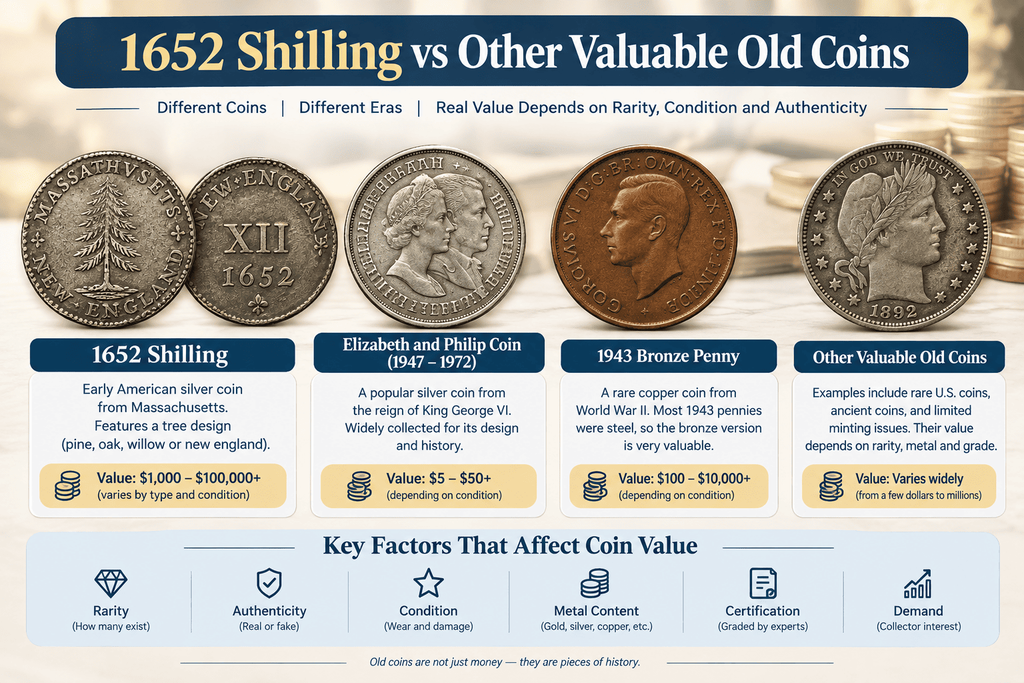
For more examples of collectible coins and historical coin values, you can also read our guides on Elizabeth and Philip coin values and the 1943 bronze penny value.
These coins are from very different periods, but they show why exact variety and authenticity are important when estimating coin value.
Final Thoughts on 1652 Shilling Value
The 1652 shilling is much more than an old silver coin.
It represents an important part of colonial American history.
The series includes the early New England pieces and the famous Willow Tree, Oak Tree, and Pine Tree designs.
The 1652 pine tree shilling is especially well known among collectors. But the 1652 date can be confusing because many coins bearing that date were actually struck years later.
A genuine 1652 shilling can be worth a significant amount of money. Some examples are worth thousands of dollars, while rare and exceptional pieces can bring much higher prices.
However, counterfeit and replica coins exist.
So, if you own or want to buy a 1652 shilling, remember one simple rule:
Never judge the value by the date alone. First confirm the exact variety and authenticity.
A real 1652 shilling can be an important historical treasure. A professional examination is the safest way to discover what you actually have.
Frequently Asked Questions About 1652 Shilling
How much is a 1652 shilling worth?
A genuine 1652 shilling value can range from thousands of dollars to much higher amounts depending on its type, rarity, condition, and authenticity. Rare varieties can be worth significantly more.
Is a 1652 pine tree shilling real silver?
Authentic Massachusetts Pine Tree Shillings are historic silver coins. However, a coin must still be authenticated because replicas and counterfeits may also exist.
Is a 1652 pine tree shilling real or fake?
Both genuine and fake examples exist. The safest method is professional authentication by a recognized coin expert or grading service. NGC has specifically documented counterfeit examples of this series.
Who made the Pine Tree Shilling 1652?
The Massachusetts mint was operated by Boston silversmiths John Hull and Robert Sanderson after the colony authorized coin production in 1652.
Was every 1652 shilling made in 1652?
No. Many Massachusetts coins continued to display the date 1652 even when they were physically struck later. Smithsonian records identify some 1652 Pine Tree Shillings as having been made between 1667 and 1682.
What is the 1652 Oak Tree Shilling?
The 1652 oak tree shilling is part of the Massachusetts colonial silver coin series. The Oak Tree design followed the Willow Tree type and preceded the famous Pine Tree type.
What is a 1652 Willow Tree Shilling?
The 1652 willow tree shilling is an early Massachusetts silver coin featuring a tree design. Genuine examples are rare and can have substantial collector value.
How much money was 20 shillings in 1652?
In the traditional British monetary system, 20 shillings equaled one pound. Its modern purchasing-power equivalent cannot be accurately represented by one simple number.
About the Author