What Is the Largest Bill in US Currency
Today, Largest Bill in US Currency is $100 bill is the largest US currency denomination currently issued by the Federal Reserve. However, the United States has produced much larger banknotes in the past, including $500, $1,000, $5,000, and $10,000 Federal Reserve Notes.
There was also an extraordinary $100,000 Gold Certificate, but it was never intended for ordinary public circulation. It was used only for transactions between Federal Reserve Banks.
This guide explains what is the Largest Bill in US currency, what the largest bill is worth, which large notes are still legally valid, when they were discontinued, and how the $100 bill became the highest denomination used in everyday U.S. currency.
What Is the Largest Bill in US Currency?
The $100 bill is the Largest Bill in US currency denomination currently issued by the Federal Reserve for public use.
The current U.S. currency denominations are:
- $1
- $2
- $5
- $10
- $20
- $50
- $100
The Federal Reserve does not currently issue new $500, $1,000, $5,000, or $10,000 notes.
Historically, however, the $10,000 bill was the largest Federal Reserve Note issued for public circulation. The U.S. government also printed a $100,000 Gold Certificate, but that note was restricted to transactions between Federal Reserve Banks and was never available for ordinary public circulation.
So, when someone asks what is the largest bill in us currency, the simplest answer is:
$100 for current U.S. currency, and $10,000 for the largest Federal Reserve Note issued for public circulation.
US Currency Explained: What Is a Bill?
Before discussing the Largest Bill in US, it helps to understand what a US currency bill actually is.
A bill, commonly called a banknote or note, is a form of paper currency issued by the United States government through the Federal Reserve system. Americans often use the word “bill” in everyday conversation, while official sources generally use the word “note.”
For example, people normally say:
- one-dollar bill
- twenty-dollar bill
- fifty-dollar bill
- hundred-dollar bill
The official term is a Federal Reserve Note.
Modern US paper currency is issued in seven denominations: $1, $2, $5, $10, $20, $50, and $100.
The $100 note is therefore the answer to what is the largest bill in u.s. currency currently issued.
Where Did the Name “Dollar” Come From?
The word dollar has a much older history than the United States.
The English word is connected to the Spanish dólar and the German thaler, a name associated with silver coins produced in the European town of Joachimsthal.
Over time, similar silver coins became known by variations of the word “thaler,” eventually developing into the English word dollar.
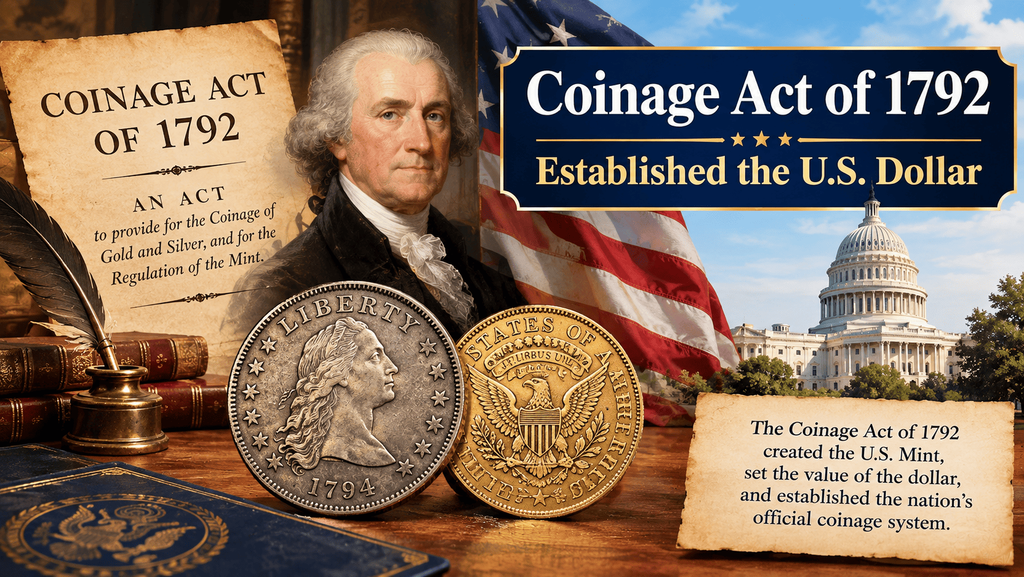
The United States adopted the dollar as its monetary unit after the creation of the U.S. monetary system in the late 18th century.
The Coinage Act of 1792 established the US dollar and created a national monetary system based on dollars, cents and smaller denominations.
This history is important because today’s $100 bill is part of a monetary system that developed over more than two centuries.
How Did U.S. Paper Currency Begin?
The United States did not begin with today’s Federal Reserve Notes.
Before the modern Federal Reserve system, the country used several different types of paper money, including:
- Demand Notes
- United States Notes
- National Bank Notes
- Silver Certificates
- Gold Certificates
- Federal Reserve Bank Notes
- Federal Reserve Notes
The Federal Reserve System was created in 1913, and Federal Reserve Notes began appearing soon afterward.
In 1918, the Federal Reserve began issuing very large denominations, including:
- $500
- $1,000
- $5,000
- $10,000
These notes were mainly useful for large financial transactions rather than everyday shopping.
What Is the Largest Bill in US Currency Today?
The answer is the $100 bill.
The Federal Reserve currently issues seven denominations, with $100 being the highest.
The modern $100 note features Benjamin Franklin, one of the Founding Fathers of the United States.
The current design includes several security features intended to make counterfeiting more difficult. These include a blue 3-D security ribbon, a color-shifting bell in the inkwell, a watermark, and other security elements.
The $100 note is therefore the Largest Bill in US currency currently issued by the Federal Reserve.
According to the US Currency Education Program, the $100 note is the largest denomination currently issued.
What Is the Largest Bill in US Currency in Circulation?
If you mean the largest denomination currently being issued and used as regular US currency, it is the $100 bill.
The important distinction is between currently issued currency and older notes that remain legal tender.
The United States stopped issuing $500, $1,000, $5,000 and $10,000 notes in 1969. However, these older notes were not simply declared worthless.
Certain older U.S. notes can still have legal-tender status, although they are extremely uncommon and are generally worth more to collectors than their face value.
In other words:
Largest currently issued denomination: $100
Largest Federal Reserve Note ever issued for public circulation: $10,000
Largest U.S. note ever printed: $100,000 Gold Certificate
These are three different answers to three slightly different questions.
What Is the Highest Bill in US Currency Ever Used by the Public?
The $10,000 bill was the highest-denomination Federal Reserve Note issued for public circulation in US.
The $10,000 Federal Reserve Note was introduced in 1918.
It featured Salmon P. Chase, who served as U.S. Secretary of the Treasury during the Civil War and later became Chief Justice of the United States.
The $10,000 denomination was created primarily for large financial transactions. It was not designed to be an everyday spending note.
For example, carrying a $10,000 note could eliminate the need to carry hundreds of smaller bills when transferring a large amount of money.
However, as banking technology improved and checks and other payment methods became more convenient, the demand for extremely large notes declined.
What Is the Largest Note in US Currency History?

The largest denomination ever printed by the Bureau of Engraving and Printing was the $100,000 Gold Certificate, Series 1934.
This is much larger than the $10,000 Federal Reserve Note.
However, there is an important catch.
The $100,000 Gold Certificate was not intended for public circulation.
It was issued only for official transactions between Federal Reserve Banks and was backed by an equivalent amount of gold held by the US Treasury.
Ordinary citizens could not walk into a bank and withdraw a $100,000 Gold Certificate.
Therefore, when people ask what is the largest note in US currency, the answer depends on the definition:
Largest note ever printed: $100,000 Gold Certificate
Largest Federal Reserve Note issued for public circulation: $10,000
Largest denomination currently issued: $100
What Happened to the $500, $1,000, $5,000 and $10,000 Bills?
The U.S. government stopped issuing the large denominations in 1969.
The discontinued denominations included:
$500 Bill
The $500 bill featured William McKinley, the 25th president of the United States, on later Federal Reserve Note designs.
$1,000 Bill
The $1,000 Federal Reserve Note featured Alexander Hamilton.
Hamilton was the first U.S. Secretary of the Treasury and played a major role in establishing the early U.S. financial system.
$5,000 Bill
The $5,000 Federal Reserve Note featured James Madison, the fourth president of the United States.
$10,000 Bill
The $10,000 Federal Reserve Note featured Salmon P. Chase.
These large denominations were discontinued because they were rarely needed. The Federal Reserve and Treasury announced the discontinuation on July 14, 1969.
Although the notes were discontinued, the last large-denomination notes had actually been printed in 1945.
Why Did the US Stop Printing Large Bills?
There were several practical reasons.
The biggest reason was lack of demand.
Most people did not need $500, $1,000, $5,000 or $10,000 notes for ordinary purchases.
As financial institutions developed better payment methods, large physical banknotes became less important.
Checks could transfer large amounts without requiring people to carry large amounts of cash. Later, electronic banking, cards and digital payments reduced the need even further.
The Federal Reserve explains that the large denominations were discontinued because of declining use.
This is one reason the $100 bill became the highest denomination in regular U.S. currency.
What Is the Largest Bill in US Currency Worth?
If you mean the largest current denomination, a $100 bill is worth $100 at face value.
But if you are asking about old large-denomination notes, their collectible value can be very different.
For example, an old $500 or $1,000 note may sell for considerably more than its face value depending on:
- Series
- Date
- Condition
- Serial number
- Federal Reserve Bank
- Rarity
- Demand from collectors
- Historical significance
The same principle applies to $5,000 and $10,000 notes.
Therefore, face value and collector value are not always the same.
An old $1,000 bill does not automatically sell for exactly $1,000. A rare example in excellent condition may command a substantial premium.
Collectors should identify the exact series and condition before estimating value.
Are Old $500, $1,000, $5,000 and $10,000 Bills Still Worth Money?
Yes, old large-denomination US notes can still be valuable.
The fact that the Federal Reserve no longer issues these denominations does not mean that every old example suddenly became worthless.
However, these notes are extremely uncommon.
If you find an old large-denomination note, do not assume that its value is only the printed denomination. It may have significant collector interest.
For example, an old $500 note could have:
Face value: $500
Collector value: potentially higher, depending on rarity and condition.
The same concept applies to larger denominations.
Before selling an old large-denomination note, it is wise to have the note properly identified and evaluated.
The $100 Bill and Its Importance in US Currency
The $100 bill has become particularly important because it is the highest denomination regularly issued today.
According to U.S. Currency Education Program circulation data, $100 notes represent a very large portion of the total value of U.S. currency in circulation.
This does not mean that there are more $100 bills than $1 bills. In fact, there are many more lower-denomination notes by number.
But because every $100 note has a high face value, $100 bills represent a large share of the total dollar value of circulating paper currency.
This helps explain why the $100 note is so important to the largest bill in US cash system.
$100 Bill vs. Old large bill in US
Here is a simple comparison:
| US Bill | Status | Historical Role |
|---|---|---|
| $1 | Currently issued | Everyday transactions |
| $2 | Currently issued | Less common denomination |
| $5 | Currently issued | Everyday transactions |
| $10 | Currently issued | Everyday transactions |
| $20 | Currently issued | Widely used |
| $50 | Currently issued | Higher everyday denomination |
| $100 | Currently issued | Highest current denomination |
| $500 | Discontinued | Large financial transactions |
| $1,000 | Discontinued | Large financial transactions |
| $5,000 | Discontinued | Large financial transactions |
| $10,000 | Discontinued | Largest public Federal Reserve denomination |
| $100,000 Gold Certificate | Restricted historical issue | Federal Reserve Bank transactions |
The table makes the answer simple: $100 is the largest denomination currently issued, while $10,000 was the largest Federal Reserve denomination issued for public circulation.
What Is the Largest Bill in US Currency Compared With Silver Certificates?
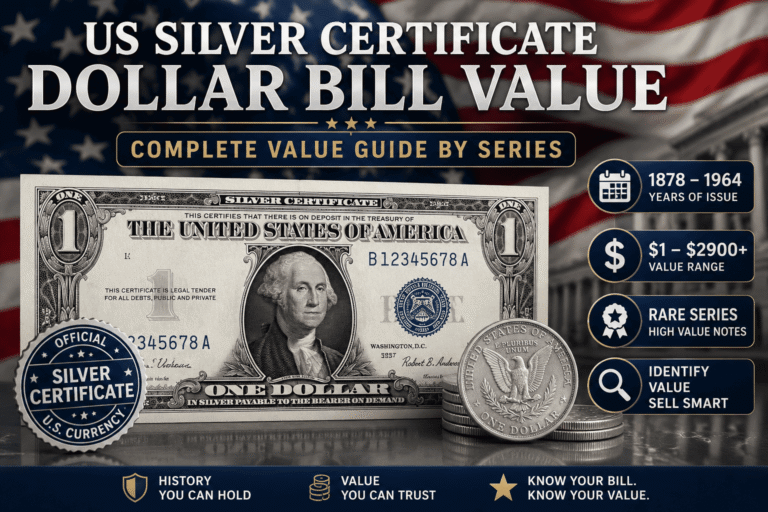
Another interesting part of largest bill in US currency history is the Silver Certificate.
Silver Certificates were once issued in several denominations and represented a different type of U.S. paper currency.
They are especially interesting to collectors because their value today can depend on the series, condition and rarity.
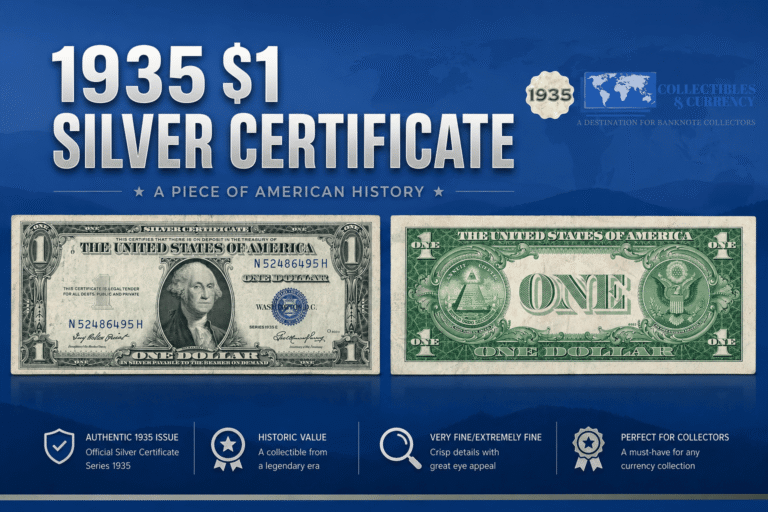
If you are researching older largest bill in US paper money, you can learn more about silver certificates in our detailed guide:
1935 Silver Certificate Dollar Worth guides can help collectors understand why the printed denomination is not always the same as the collectible market value.
Why the $100 Bill Is Now the Highest Regular US Note
The United States has no current need for extremely large physical banknotes.
Modern financial systems can move large amounts of money electronically, through bank transfers and other financial networks.
For everyday cash transactions, denominations up to $100 are generally sufficient.
This is why the largest bill in US currency system today uses seven Federal Reserve Note denominations:
$1, $2, $5, $10, $20, $50 and $100.
The Federal Reserve continues to issue these denominations according to demand.
Is the $100 Bill the Largest Bill You Can Get From a Bank?
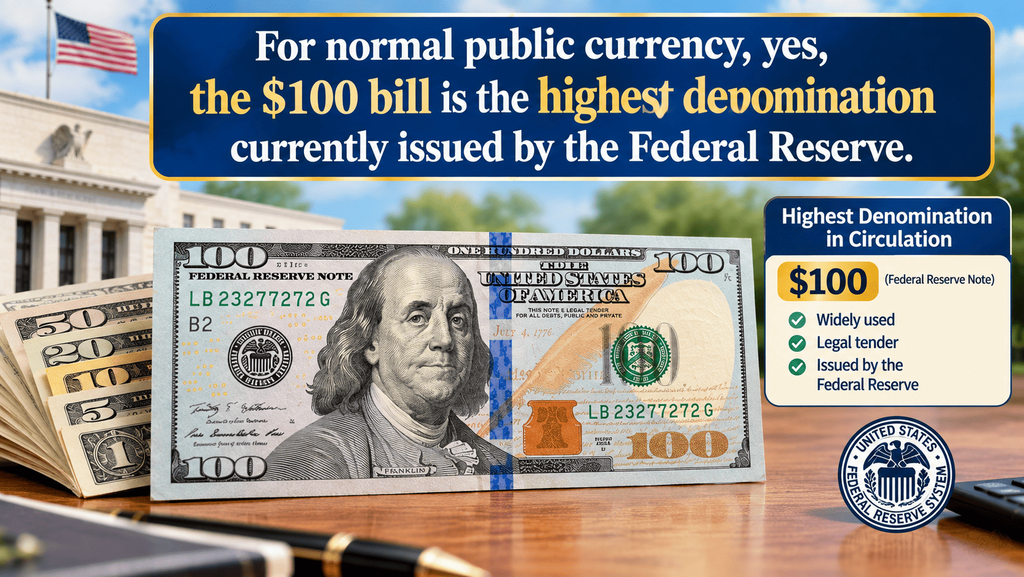
For normal public currency, yes, the $100 bill is the highest denomination currently issued by the Federal Reserve.
Banks may have different amounts of cash available at different times, but they do not receive newly issued $500, $1,000, $5,000 or $10,000 Federal Reserve Notes.
If a person wants a large amount of cash, it is normally provided using combinations of currently issued denominations.
For example:
$1,000 can be represented by:
- 10 × $100 bills
- 20 × $50 bills
- 50 × $20 bills
Rather than one current $1,000 bill.
Why People Search for the Largest Bill in US
largest bill in US currency is popular among collectors, history enthusiasts and people who discover old U.S. banknotes.
People often find photographs of $500, $1,000 or $10,000 bills online and wonder whether such notes are still used.
The answer is that these denominations are part of American currency history rather than today’s regular currency system.
They also attract collectors because large-denomination notes were produced in relatively limited quantities and were often used for specialized financial transactions.
Frequently Asked Questions about largest bill in US
1. What is the largest bill in U.S. currency?
The $100 bill is the largest U.S. currency denomination currently issued by the Federal Reserve for public use. Historically, the largest Federal Reserve Note issued for public circulation was the $10,000 bill.
2. What is the largest bill in US currency worth?
The largest current bill is the $100 note today, is worth $100 at face value. Older $500, $1,000, $5,000 and $10,000 notes may be worth more than face value to collectors depending on their rarity, series and condition.
3. What is the largest bill in US currency in circulation?
The $100 bill is the largest denomination currently issued and used as regular U.S. currency. Older large denominations are no longer issued.
4. What is the highest bill in U.S. currency ever issued for public circulation?
The $10,000 Federal Reserve Note was the highest-denomination Federal Reserve Note issued for public circulation. It was discontinued in 1969.
5. What is the largest note in U.S. currency history?
The largest denomination ever printed by the Bureau of Engraving and Printing was the $100,000 Gold Certificate, Series 1934. It was not intended for public circulation and was used for transactions between Federal Reserve Banks.
Conclusion:
For modern largest bill in US currency is $100. It is the highest denomination currently issued by the Federal Reserve for public use.
However, American currency history includes much larger notes. The Federal Reserve once issued $500, $1,000, $5,000 and $10,000 notes, with the $10,000 bill being the largest Federal Reserve Note issued for public circulation.
largest bill in US also printed a remarkable $100,000 Gold Certificate in 1934, but it was never intended for ordinary public use. It was restricted to transactions between Federal Reserve Banks.
Therefore, remember these three important answers:
Largest current U.S. bill: $100
Largest Federal Reserve Note issued for public circulation: $10,000
Largest US note ever printed: $100,000 Gold Certificate
About the Author