
What is national finance commission
If you have ever wondered what is National Finance Commission and why it appears constantly in Pakistani news headlines, you are not alone. The Finance National Commission is one of most important least yet understood institutions in Pakistan economic and political system. It decides quietly how much money each province receives every year, which in turn schools shapes, hospitals, roads and salaries across country.
In this guide we break down what National Finance Commission is, how it works, its history, its status current in 2026 and why every citizen should care about it.
What Is National Finance Commission ? Quick Answer
The National Finance Commission NFC is constitutional body in Pakistan responsible for recommending how tax revenue collected by federal government should be shared between federation and the four provinces Punjab, Sindh, Khyber Pakhtunkhwa and Balochistan. It is formed under Article 160 of Constitution of Pakistan and is roughly reconstituted every five years. The recommendations of the National Finance Commission are formally issued as the NFC Award, which becomes legal basis for federal provincial revenue sharing for the next several years.
In short the National Finance Commission answers one core question who gets what share of the national tax pool and how is that share calculated ?
Understanding the National Finance Commission in Simple Terms
Pakistan collects most of its taxes income tax, sales tax, customs duties and excise federal duty through central government. But the provinces are ones responsible for delivering healthcare, education, policing and local infrastructure. This creates gap natural between who collects the money and who needs to spend it.
The National Finance Commission exists to close that gap. It brings together the federal finance minister, the finance ministers of all four provinces and technical experts to agree on fair formula for splitting the national divisible pool of taxes. Once this formula is approved by President of Pakistan, it becomes binding for the entire country.
There are two types of distribution the National Finance Commission handles
- Vertical distribution how much money goes to the federal government versus the provinces combined.
- Horizontal distribution how the provincial share is then divided among Punjab, Sindh, KP and Balochistan.
Both decisions are made by the same body, which is why the NFC carries so much political and economic weight.
Constitutional Basis of the National Finance Commission
The legal foundation of National Finance Commission comes from Article 160 of 1973 Constitution of Pakistan. This article requires President to constitute National Finance Commission within six months of taking office and at not intervals exceeding five years afterward. The commission must include federal finance minister, the provincial finance ministers and any additional members President appoints after consulting the provincial governors.
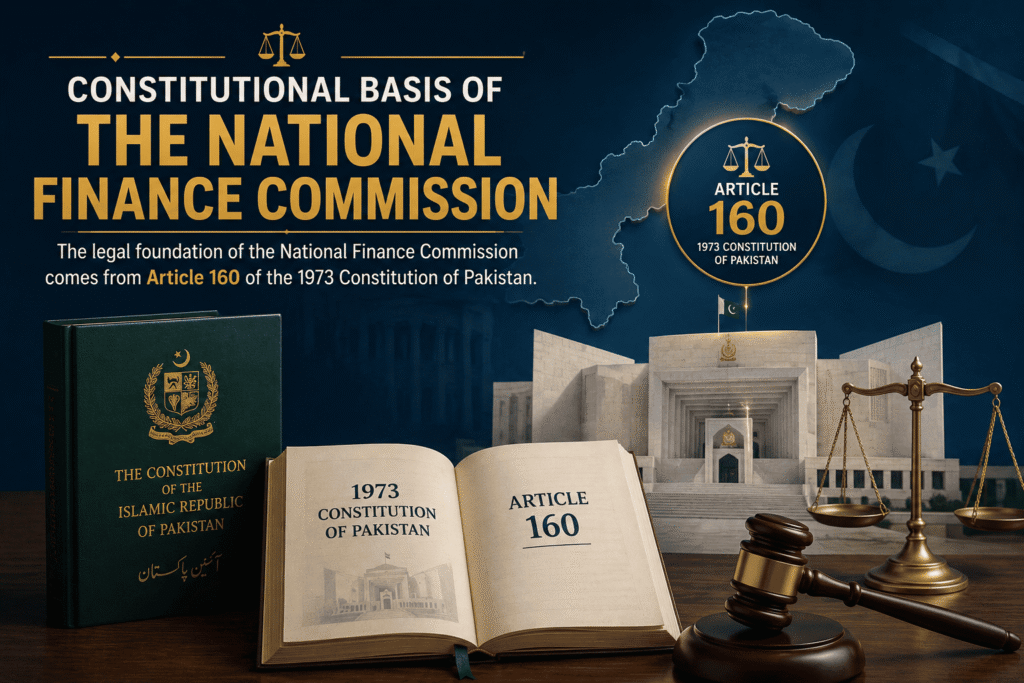
This requirement constitutional is what makes the NFC a permanent, recurring feature of Pakistan fiscal system rather than a one time committee. Every five years, a new commission is expected to review the existing formula and propose an updated award based on current economic realities.
A Brief History of National Finance Commission Awards
The idea behind the National Finance Commission predates Pakistan’s current constitution. Revenue-sharing between the center and provinces goes back to the Government of India Act, 1935, when Sir Jeremy Raisman designed the first formal distribution mechanism — later renamed in Pakistan’s context as the National Finance Commission.
Since the 1973 Constitution came into force, Pakistan has seen several NFC Awards, including:
- 1st NFC Award (1975) – the first award issued under the new constitutional framework.
- 1990s Awards – incremental changes with population remaining the dominant distribution criterion.
- 1997 and 2006 Awards – attempts to expand the divisible pool, with the 2006 presidential ordinance raising the provincial share toward 50%.
- 7th NFC Award (2009–2010) – widely seen as the most significant award of them all, raising the provincial share of the divisible pool from 47.5% to 57.5% and introducing multiple distribution criteria beyond population alone.
For nearly fifteen years after 2010, the 7th NFC Award remained in effect because subsequent commissions — including the 8th, 9th, and 10th — could not reach a full consensus on a replacement formula, so the President extended the existing award year after year.
How the National Finance Commission Formula Works
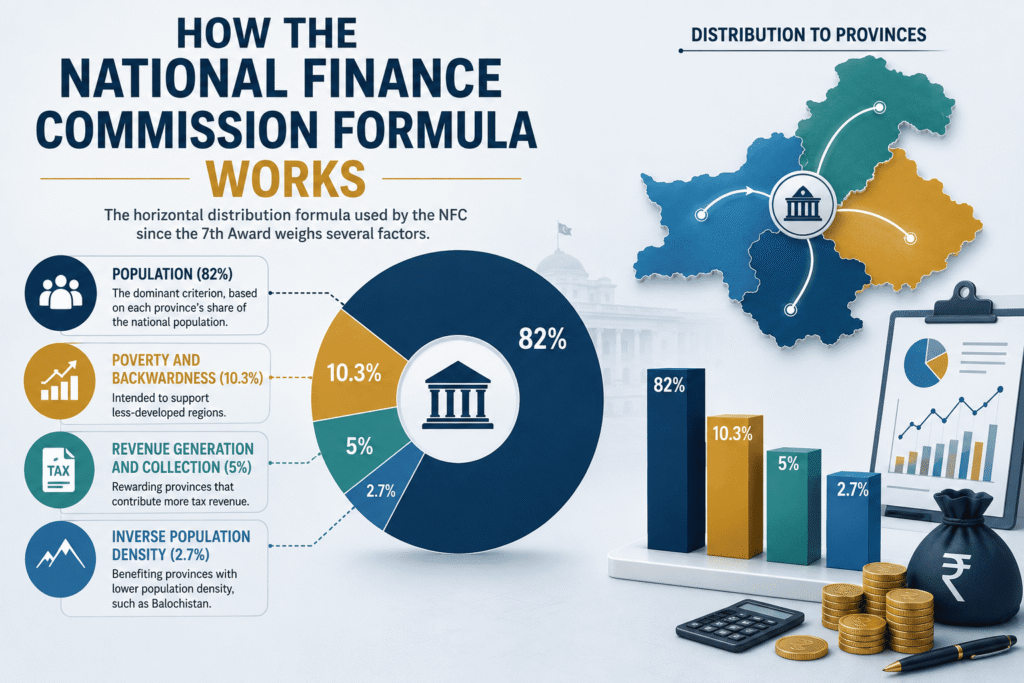
The horizontal distribution formula used by the NFC since the 7th Award weighs several factors:
- Population (82%) – the dominant criterion, based on each province’s share of the national population.
- Poverty and backwardness (10.3%) – intended to support less-developed regions.
- Revenue generation and collection (5%) – rewarding provinces that contribute more tax revenue.
- Inverse population density (2.7%) – benefiting provinces with lower population density, such as Balochistan.
This formula illustrates why the commission is politically sensitive: provinces with larger populations, like Punjab, benefit most from the population weight, while smaller provinces argue for greater weight on poverty, land area, or revenue generation.
Composition and Structure of the National Finance Commission
Each National Finance Commission is composed of:
- The Federal Minister for Finance, who typically chair commission.
- The Finance Ministers of Punjab, Sindh, Khyber Pakhtunkhwa and Balochistan as members statutory.
- The Federal Finance Secretary as an official member.
- Technical and non-statutory members nominated by provincial governments.
This structure ensures that every province has a formal seat at the table whenever the commission negotiates a new award, though final decisions still require broad consensus, which can take years to achieve.
Functions and Objectives of the National Finance Commission
The core objectives of the National Finance Commission include:
- Determining the size of the federal divisible pool of taxes.
- Deciding the vertical share between the federal government and the provinces.
- Deciding the horizontal share among the four provinces.
- Recommending grants-in-aid for provinces facing fiscal difficulty.
- Reducing regional and horizontal fiscal imbalances across the federation.
By fulfilling these functions, it plays a direct role in how much money is available for provincial development budgets, salaries, and public services every single year.
The Current Status of the National Finance Commission (2025–2026)
As of 2026, Pakistan is in the middle of forming its 11th National Finance Commission. The term of the 10th NFC Award expired in July 2025, and the federal government has since constituted technical working groups to negotiate a new formula. The inaugural session of the 11th National Finance Commission was held in December 2025, with provinces — particularly Khyber Pakhtunkhwa — pushing for their population and constitutional responsibilities to be reconsidered following the merger of the former tribal districts.
Progress has been slow. Only a handful of the eight technical working groups formed under the 11th NFC had met by early 2026, and the federal finance minister has publicly acknowledged that the population-heavy formula may need to be reviewed as part of broader structural reform. Provincial governments have also begun approaching Pakistan’s courts to seek a reinterpretation of how the formula should apply given demographic and constitutional changes since 2010.
Until a new consensus is reached, the 7th NFC Award — technically expired but repeatedly extended — continues to guide how resources are distributed across the federation.
Why the NFC Matters to Ordinary Citizens
It is easy to think of National Finance Commission as dry, technical topic reserved for economists and bureaucrats. In reality its decisions affect everyday life directly, in much same way that your own personal finance habits shape your household future:
- Healthcare and education budgets in every province depend on the share allocated through the National Finance Commission.
- Local infrastructure, including roads, supply water and public transport, is funded largely through provincial budgets shaped by National Finance Commission Award.
- Regional inequality between richer and poorer provinces is either reduced or worsened depending on how NFC formula is designed.
- Political stability between federation and provinces often hinges on whether commission can reach fair, timely consensus.
Common Challenges Facing the NFC
Despite its constitutional importance, the NFC faces challenges recurring:
- Heavy reliance on population as main criterion distribution, which critics ignores argue development needs, revenue effort and geography.
- Long delays in reaching consensus, leaving outdated awards in place for over decade at a time.
- Lack of permanent secretariat with full time technical experts, which slows negotiations between National Finance Commission sessions.
- Rising federal expenditures, such as debt servicing and defense, which put pressure on the shrinking federal share after provincial transfers.
Addressing these challenges is central to the ongoing 11th National Finance Commission process.
NFC vs. Annual Federal Budget
People often confuse National Finance Commission with the annual federal budget, but two serve different purposes. The budget federal is an annual document that outlines government spending and revenue projections for single fiscal year. The NFC, by contrast, sets the underlying formula that determines how much of the national divisible pool each province receives before the budget is even drafted.
In practice annual budget making process for both the federal government and the provinces works within boundaries already set by the current National Finance Commission Award. A province cannot budget for more than its share agreed, which is why disagreements within commission tend to ripple outward into broader debates about autonomy provincial, debt management and development spending across entire country.
From National Finance to Household Finance
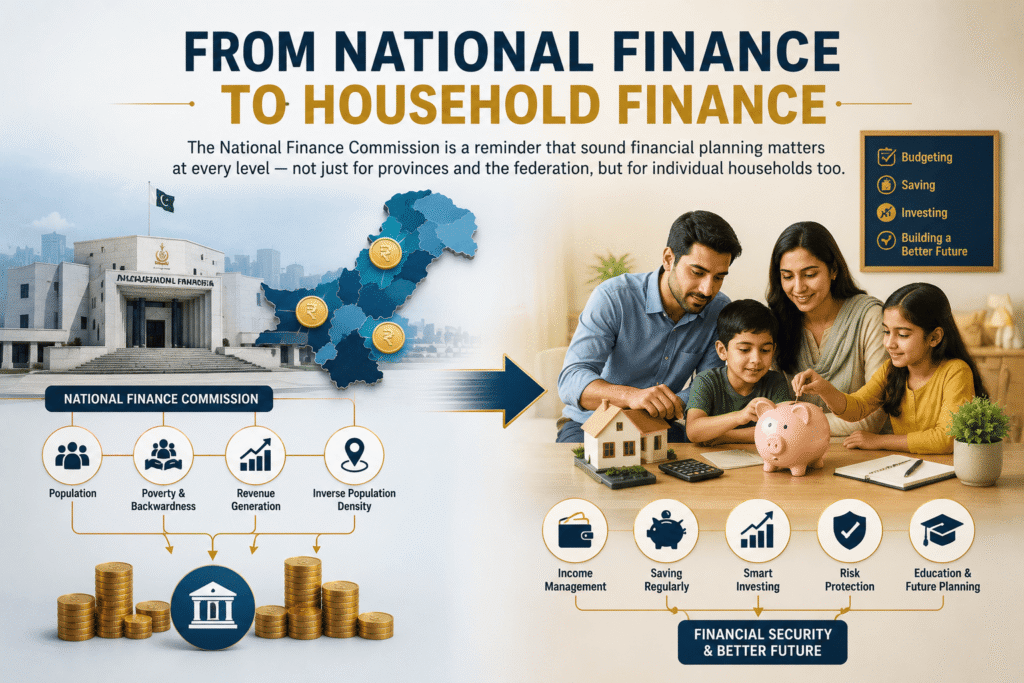
The National Finance Commission is a reminder that sound financial planning matters at every level — not just for provinces and the federation, but for individual households too. Just as NFC protects provinces against fiscal imbalance, everyday protect families themselves against financial risk through tools like the different types of car insurance coverage, life insurance for stay-at-home moms and even niche protections such as house cleaning insurance. Whether it’s country tax distributing revenue or family budgeting for risk, underlying principle is the same: a fair, well planned formula protects everyone involved.
Key Takeaways:
- The National Commission Finance decides how tax federal revenue is split between Islamabad and the four provinces.
- It operates under Article 160 of Constitution and is reconstituted at least every five years.
- The 7th NFC Award of 2010 remains the operative formula, extended repeatedly while newer commissions negotiate a replacement.
- The 11th National Finance Commission, formed after 10th award expired in July 2025, is working still toward new consensus in 2026.
- Its decisions directly healthcare shape, education and infrastructure funding at provincial level.
Frequently Asked Questions About NFC:
What is National Finance Commission in simple words ? The National Finance Commission is constitutional body that decides how money tax collected by Pakistan’s federal government is shared with the four provinces.
Who created National Finance Commission ? The National Finance Commission was established under Article 160 of 1973 Constitution of Pakistan, building on revenue sharing practices that date back to 1951.
How often is National Finance Commission reconstituted ? The Pakistani President must reconstitute National Finance Commission at intervals not exceeding five years.
What was the most important National Finance Commission Award? The 7th NFC Award of 2009–2010 is widely regarded as most significant National Finance Commission Award, since it raised the provincial share of divisible pool to 57.5%.
Is there new National Finance Commission Award in 2026 ? As of 2026 11th National Finance Commission is still negotiating a new award; until consensus is reached, extended 7th NFC Award remains formula in effect.
Conclusion
The National Finance Commission may quietly operate in background of Pakistan’s economy, but its influence touches nearly every public citizens service rely on. From hospital funding to road construction, the decisions made by this commission shape how fairly resources are shared between Islamabad and the provinces. As the 11th National Finance Commission continues its negotiations in 2026, understanding how this body works — and why it matters — is more relevant than ever for anyone following Pakistan’s economic and political future.
About the Author







1 thought on “What Is National Finance Commission? A Complete Guide to Pakistan’s NFC Award”