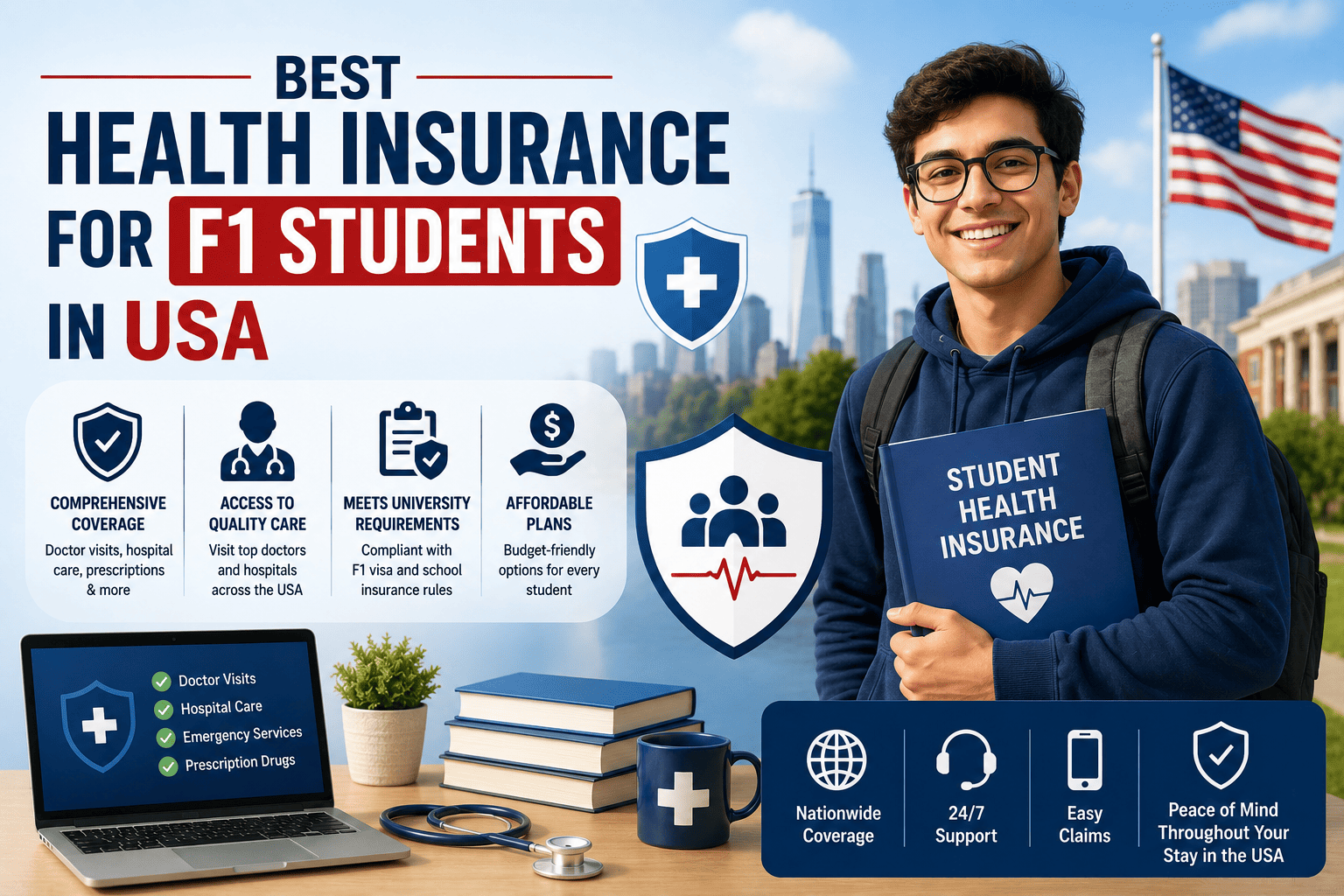
the best health insurance for f1 students in usa
Finding best health insurance for F1 students in USA colleges and universities can feel overwhelming, especially when you’re also adjusting to new country, new school and a new healthcare system. Unlike your home country, medical care in the United States is expensive single emergency room visit can cost thousands of dollars without coverage. This guide breaks down what exactly F1 visa holders need to know before choosing plan, requirements including, top providers, real costs and how to avoid common mistakes.
Quick Answer: What’s Best Health Insurance for F1 Students in USA ?
There is no single universal answer because the right plan depends on your university specific waiver requirements, your budget and your health needs. That said most consistently recommended options for best health insurance for F1 students in USA in 2026 include university student sponsored health plans often through Student Aetna Health or United Healthcare Student Resources and international private student plans like ISO Student Health Insurance, IMG Patriot Program Exchange, World Trips Student Secure and Geo Blue Student. Most of these plans start between roughly $30 and $90 per month, depending on level coverage and schools requirements.
Do Need Health Insurance for F1 Students in USA ?
The U.S. federal government does not mandate legally Health Insurance for F1 Students in USA visa holders way it does for exchange J1 visitors. However every nearly accredited college and university in United States requires proof of health insurance before you can register for classes. Schools set this requirement because uninsured medical treatment in America can lead to large bills enough to derail student entire academic plan.
This means your school not U.S. government decides what counts as adequate coverage. Before shopping for plan, always check your international student office’s insurance policy page, since every institution sets its own minimum standards for waiver approval.
What Makes an F1 Student Health Insurance Plan Worth Choosing?
Not all plans that are marketed to international students actually satisfy university waiver requirements. When comparing options for the best health insurance for F1 students in USA, look for these core benefits, which most U.S. schools require:
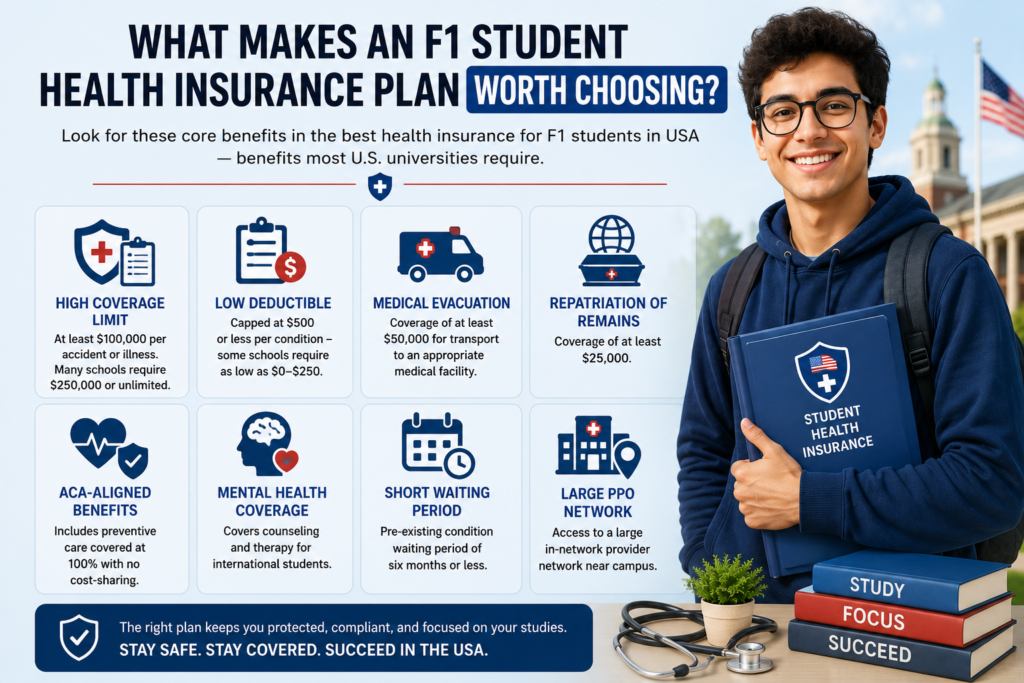
- Policy maximum of at least $100,000 per accident or illness, though many universities now require $250,000 or unlimited coverage.
- Deductible capped at $500 or less per condition — some schools require as low as $0–$250.
- Medical evacuation coverage of at least $50,000, covering transport to an appropriate medical facility.
- Repatriation of remains coverage of at least $25,000.
- ACA-aligned essential health benefits, including preventive care covered at 100% with no cost-sharing.
- Mental health coverage, since counseling and therapy are heavily used by international students adjusting to life abroad.
- A short pre-existing condition waiting period, ideally six months or less.
- A large in-network provider (PPO) network so you’re not stuck paying full price near campus.
If a plan is missing any of these, it likely will not qualify for your school’s F1 waiver, even if it’s cheap.
Top-Rated Health Insurance for F1 Students in USA Option
Here are the most widely used and university-accepted plans for F1 students in the USA in 2026:
1. University-Sponsored Student Health Plans Most large universities partner with a major insurer — commonly Aetna Student Health or United Healthcare Student Resources (UHCSR) — to offer a school-branded plan. These typically run $60–$120 per month, include a low or zero deductible, and are automatically ACA- and waiver-compliant since the school designed them to meet its own requirements.
2. ISO Student Health Insurance One of the most affordable and widely accepted private options, with plans starting around $30–$35 per month at the basic tier. ISO offers multiple tiers, from a low-cost “Smart” plan to a comprehensive “Elite” tier with maternity coverage and no deductible.
3. IMG’s Patriot Exchange Program A long-established option built specifically for international students and exchange visitors, with pricing that typically starts around $55–$60 per month depending on coverage limits and deductible selection.
4. WorldTrips StudentSecure Offers multiple coverage tiers (Budget, Select, and Elite), letting students scale coverage up as their needs change — including options for sports injuries and pre-existing conditions after a waiting period.
5. GeoBlue Student A premium option known for strong customer service and a broad PPO network, often priced higher than budget plans but well-regarded for claims processing and coverage in over 180 countries, useful if you travel during breaks.
University-Sponsored vs. Private Health Insurance for F1 Students in USA
Many F1 students assume they must use their university’s default plan, but most schools allow a “waiver” if you can prove your outside plan meets or exceeds their requirements. Here’s how to weigh the two options:
- University-sponsored plans are simple to enroll in, automatically compliant, and often include direct billing with the campus health center — but they can cost significantly more than private alternatives.
- Private international student plans are often 30–60% cheaper for the same coverage level, but you are responsible for confirming compliance yourself and submitting waiver paperwork by your school’s deadline, which is often before the semester starts.
If your goal is finding the best health insurance for F1 students in USA institutions at the lowest possible cost, comparing a private waiver-eligible plan against your school’s default option is almost always worth the extra research time.
Average Cost of Health Insurance for F1 Students in USA
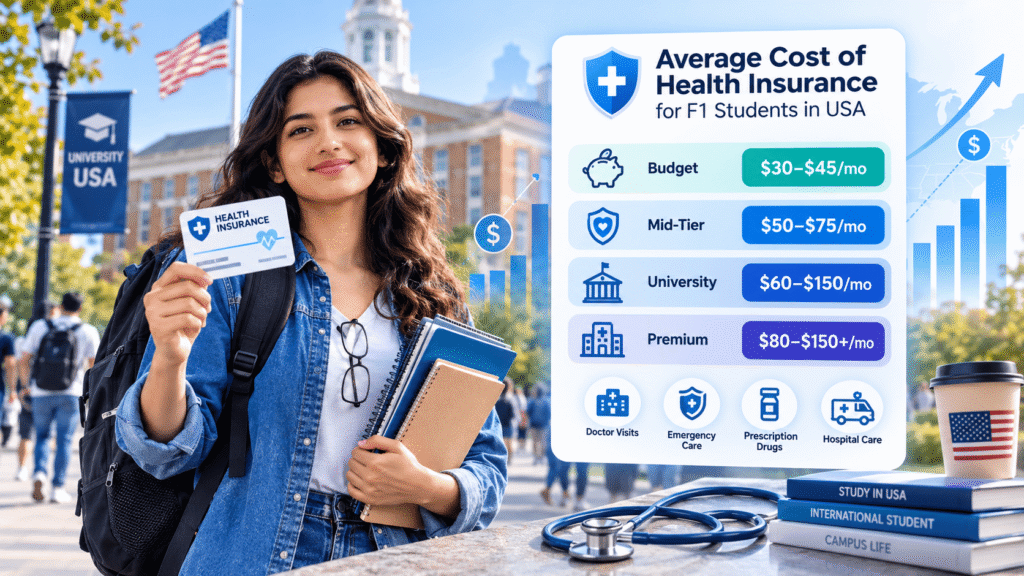
Costs vary by age, state, coverage tier, and provider, but here’s a general 2026 range for the best health insurance for F1 students in USA:
- Budget private plans: $30–$45 per month
- Mid-tier private plans: $50–$75 per month
- University sponsored plans $60–$150 per month
- Premium/comprehensive plans $80–$150+ per month
Keep in mind that cheapest plan is not always best value. A low monthly premium paired with high deductible or low policy maximum can leave you with large out of pocket costs during an actual medical emergency.
F1 vs. J1 Student Health Insurance: What is Difference ?
If you’re comparing notes with friends on a J1 exchange visa, don’t assume your insurance requirements are the same. J1 visa holders are subject to strict, federally mandated minimums set by the U.S. Department of State — including specific coverage amounts for medical evacuation, repatriation, and deductibles that cannot legally be waived. F1 students have no equivalent federal mandate; your requirements come entirely from your university, which means coverage rules can vary widely from one school to another, even within the same state.
In practice this gives F1 students more flexibility to shop around for value, but it also means you can’t simply copy friend insurance plan and assume it will satisfy your own school’s waiver checklist. Always confirm directly requirements with your international student office rather than relying on secondhand advice.
What Happens to Your Insurance After Graduation, During OPT:
Many F1 students are surprised to learn that most university-sponsored student health plans end automatically the moment you graduate or drop below full-time enrollment — including during Optional Practical Training (OPT). Since OPT participants are not eligible for employer-sponsored coverage in most cases and are no longer covered by their school’s plan, this creates a coverage gap at exactly the time many students are working their first U.S. job and can least afford a lapse in coverage.
If you’re approaching graduation, look into short-term or OPT-specific plans in advance — providers like ISO and World Trips offer plans designed specifically to bridge this transition, so you’re not left uninsured while your employer-sponsored benefits are still pending or unavailable.
How to Choose Right Plan for Your Situation
When narrowing your options consider:
- Your university’s exact waiver checklist — this eliminates any plan that won’t be approved, regardless of price.
- Whether you have an existing medical condition, since pre-existing condition waiting periods vary significantly between providers.
- Your campus location, since provider networks are stronger in some states and cities than others.
- Whether you plan to travel internationally during school breaks which may require broader geographic coverage.
- Mental health needs since counseling access and visit limits differ widely between plans.
- Your total household budget, factoring in tuition, living costs, and insurance together rather than insurance in isolation.
- State-specific healthcare costs, since prices for the same procedure can vary significantly between states like California, New York, and Texas — a strong nationwide PPO network matters more if you plan to travel between states for internships or breaks.
- Family or dependent coverage, if you’re bringing a spouse or child on an F2 visa, since not every F1 plan automatically extends to dependents at the same rate.
Other Financial Protections Every F1 Student Should Know About
Health insurance is just one part of building financial stability while you study in the United States. Many students eventually need other types of coverage too, such as understanding the different types of car insurance coverage available in the US before buying or renting a vehicle for the first time, or reviewing house cleaning insurance if you plan to take on part-time home cleaning or service work during your studies.
Managing insurance costs is also closely tied to your everyday money habits. Our detailed guide on why personal finance depends upon your behavior explains how small daily spending patterns affect your ability to afford proper coverage. And if you’re on F1 status with a spouse who stays home to care for children, it’s worth reading about life insurance options for stay-at-home moms to help protect your family’s financial future while you complete your degree.
If you come from a country where public financial systems work differently than in the US, it can also help to understand what the National Finance Commission is and how national tax revenue gets distributed back home in Pakistan, since comparing the two systems often makes US healthcare costs and insurance rules easier to understand.
Common Mistakes Health Insurance for F1 Students in USA, When Buying Health Insurance
- Assuming the cheapest plan automatically qualifies for a university waiver — always verify against your school’s specific requirements before purchasing.
- Missing the waiver submission deadline, which often results in being automatically billed for the more expensive school-sponsored plan.
- Ignoring the deductible and policy maximum in favor of a lower monthly premium.
- Forgetting to confirm mental health and prescription coverage, which many students end up needing during their first year.
- Not renewing on time since gaps in coverage can jeopardize both your health and your F1 visa status at some institutions.
FAQS: About Health Insurance for F1 Students in USA
Is health insurance mandatory for F1 students in USA ? The federal government does not require it but all nearly U.S. colleges and universities mandate proof of qualifying health insurance before you can enroll in classes.
What is the best health insurance for F1 students in USA colleges on tight budget ? Private plans like ISO Student Health Insurance often offer lowest monthly premiums among waiver eligible options, though you must confirm compliance with your specific school first.
Can F1 students use their university’s insurance instead of a private plan ? Yes, University sponsored plans are almost always automatically accepted since the school designs them to meet its own requirements, though they typically cost more than private alternatives.
How much does F1 student health insurance cost per month ? Most plans range from about $30 to $150 per month in 2026, depending on provider, tier coverage, deductible and whether the plan is university sponsored or private.
Does F1 student health insurance cover mental health services ? Most modern plans include mental health coverage, but visit limits and inpatient or outpatient benefits vary significantly between providers, so it’s worth comparing this specifically.
Conclusion
There’s no one size fits all answer to finding best health insurance for F1 students in USA schools the right choice depends on your university’s waiver requirements, your budget and needs your personal health. Start by reviewing your international student office’s insurance policy, compare at least two or three waiver eligible plans side by side and prioritize limits coverage and deductibles over lowest sticker price. Getting this decision right early in your protects program both your health and your finances for rest of your studying time in the United States.
About the Author







1 thought on “Best Health Insurance for F1 Students in USA Today”